Authentication Cookie Spoofing in OWASP WebGoat
August 9, 2023
In the realm of cybersecurity and web application security, projects like OWASP WebGoat play a pivotal role in enhancing our understanding of vulnerabilities and secure coding practices. As a core contributor to the OWASP WebGoat project, I have taken on the responsibility of porting, refactoring, and reviving various legacy training scenarios, breathing new life into lessons from earlier iterations of the platform. In this pursuit, my recent focus has been on revamping the Authentication Cookie Spoofing scenario, a critical module in the web security education arsenal. By re-engineering and modernizing this challenge, my goal is to provide learners with an enriched, contemporary hands-on experience that accurately reflects the ever-evolving threat landscape.
This article shines a spotlight on the mechanics of authentication cookie spoofing. This exploitation vector involves leveraging cryptographic or logical flaws within a web application to impersonate legitimate sessions by manually forging or manipulating session tokens. By dissecting the underlying mechanics of this attack vector, developers and security analysts can better grasp the nuances of session management security and effective access control mitigations.
It is worth noting that several write-ups and walkthroughs already exist to guide students through this lesson. Some notable references include:
- [A1] Spoofing an Authentication Cookie - WebGoat
- Web Security Unmasked: Spoofing Authentication Cookies - A Satirical Tutorial
My objective here is to provide deeper architectural context and discuss how the lesson was implemented. I will share technical insights into the design decisions made, the engineering challenges encountered, the didactic methodology behind the lesson, and the technology-agnostic solution blueprint that I consistently integrate into my challenge designs.
Deciphering the Authentication Cookie: An Introduction
Authentication cookies-commonly referred to as session cookies-are foundational components of modern web application state management. Because HTTP is inherently stateless, these tokens are generated and issued by the web server upon successful authentication to uniquely identify and validate a client’s subsequent requests. Operating as a temporary digital credential, the cookie allows users to navigate restricted sub-directories or execute authorized actions without repeatedly prompting them for credentials. To prevent tampering, production-grade session tokens typically rely on cryptographically secure identifiers or signed claims (such as JWTs) to maintain a seamless yet resilient security posture.
A session represents the logical, time-bound connection between a client and a web server, allowing the backend architecture to track stateful interactions across multiple endpoints.
When a user authenticates successfully, the backend engine instantiates a unique session identifier (Session ID). This token is sent to the client via a Set-Cookie header and stored locally in the browser’s cookie jar. For every subsequent request, the browser automatically appends this cookie, allowing the server to retrieve the corresponding state, user privileges, and temporary data from its session store.
Essentially, the authentication cookie serves as the key linking the user’s browser session to their authenticated identity. However, storing this state on the client side introduces specific risk vectors. If misconfigured, cookies are highly susceptible to exfiltration via Man-in-the-Middle (MitM) interceptions, Cross-Site Scripting (XSS) payload execution, or session fixation attacks. Furthermore, if the underlying generation algorithm relies on predictable patterns rather than cryptographically secure pseudo-random numbers (CSPRNGs), an attacker can reverse-engineer the generation logic and forge valid tokens out of thin air.
Once a valid token is forged, many applications will automatically authenticate the bearer, bypassing the primary credential verification layer entirely.
Decoding and Unraveling: A Comprehensive Exploration
The technical objective of this challenge is to reverse-engineer the application’s cookie generation methodology. By discovering the structural pattern of the token, an attacker can craft a valid cookie for any targeted identity from scratch. This allows the attacker to execute an authentication bypass, effectively masquerading as a high-privilege user on the platform.
The lesson displays a standard login interface requesting a username and password.
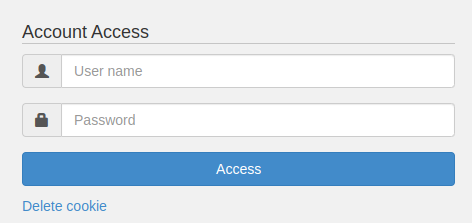
The authentication lifecycle behaves as follows:
- If the inbound HTTP request contains a valid
spoof_authcookie, the application immediately processes the session as authenticated. - If the request lacks this cookie but provides valid database credentials, the application authenticates the user and generates a new
spoof_authcookie. - If neither condition is met, access is denied.
Our ultimate objective is to log in as the user “Tom” without knowing his password.
To analyze the token generation behavior, we can log in using one of the low-privilege test credentials provided in the lesson hints and inspect the issued cookie:
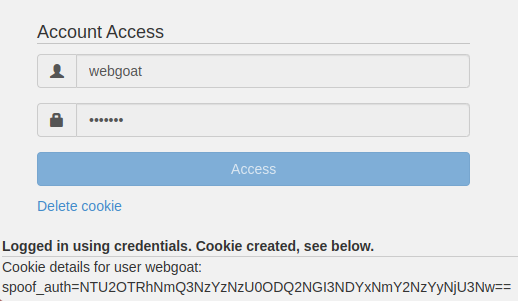
The intercepted cookie string is clearly Base64 encoded. If we strip the encoding layers via the terminal, we can see that the resulting string reveals a secondary encoding layer-specifically, a Hex-encoded string:
echo NjM3OTRhNGY0ODRiNTQ0OTU3NDU3NDYxNmY2NzYyNjU3Nw== | base64 -d
63794a4f484b5449574574616f67626577

echo 63794a4f484b5449574574616f67626577 | xxd -p -r
cyJOHKTIWEtaogbew
Decoding the raw hex reveals an alphanumeric string consisting of a recognizable username segment accompanied by an appended string of characters. By requesting multiple cookies for the same user across different test cycles, we can deduce the structural blueprint: the application concatenates a 10-character random string (acting as a predictable salt) to the username.
Crucially, the logic then reverses the entire concatenated string (e.g., turning webgoatEWITKHOJyc into cyjOHKTIWEtaogbew), before sequentially passing it through Hex and Base64 encoding functions.
Forging the Key: Exploiting the Crafted Cookie for Unauthorized Access
Armed with this structural pattern, we can manually forge a valid authentication cookie for Tom.
Because our target is a black-box scenario where we don’t have the exact salt value, a common approach in this lesson is leveraging the predictable pattern behavior. If the application’s implementation allows us to supply a deterministic string of characters (or if we exploit the predictability of the 10-character salt buffer), we can simulate the token construction. Let’s assume a static padding block for our target payload:
We take the username tom and append our 10-character block (AAAAAAAAAA). Next, we reverse the entire string:
tomAAAAAAAAAA $\rightarrow$ AAAAAAAAAAmot
Now, we process the reversed payload through the discovered encoding layers (Hex followed by Base64):
# Note: Ensure no trailing whitespaces or newline characters are encoded
echo -n AAAAAAAAAAmot | xxd -ps
414141414141414141416d6f74

# Note: Convert the raw hex representation straight into Base64
echo -n 414141414141414141416d6f74 | base64
NDE0MTQxNDE0MTQxNDE0MTQxNDE2ZDZmNzQ=
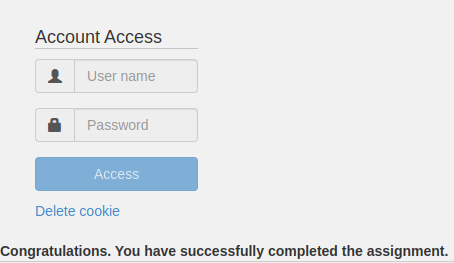
By injecting NDE0MTQxNDE0MTQxNDE0MTQxNDE2ZDZmNzQ= as the value of the spoof_auth cookie into our browser’s developer tools and refreshing the page, the backend processes the forged token, completely bypassing credential verification and granting us full access to Tom’s account.

Implementation Insights: Remediation Strategies for Secure Session Management
Relying on weak encoding schemes or predictable obfuscation (such as reversal, Hex, and Base64) to secure session tokens introduces critical security vulnerabilities. Encoding is fundamentally different from encryption; it is a deterministic data formatting method that offers zero confidentiality. When an application trusts client-side state without proper cryptographic signing or encryption, it invites widespread authentication bypasses and session hijacking vectors.
Developers must avoid rolling custom session-token generation algorithms. Secure session management demands a high degree of entropy and cryptographic rigor that ad-hoc code rarely achieves.
The industry standard mitigation is to delegate session handling entirely to established security frameworks and battle-tested libraries. These ecosystems handle session lifecycle security behind the scenes utilizing cryptographically secure pseudo-random number generators (CSPRNGs), enforcing proper cookie attributes (HttpOnly, Secure, SameSite), and validating token signatures automatically. Transitioning from home-grown token handling to framework-driven implementation is a critical step toward fortifying production environments against sophisticated modern threats.